Large language models (LLMs) are changing how scientists write papers. How can authors benefit without sacrificing quality? In response, Institut Pasteur invites Agent Majeur to run a two-day course that brings researchers to the state of the art of LLMs in scientific writing and publishing. This workshop raises awareness of fast-moving issues and imparts to each participant a working protocol for their own use.
The need
Most researchers began using LLMs to write informally and without guidance, while publishers were still drafting the rules. The tools, meanwhile, keep improving: the length of tasks they can complete autonomously has doubled roughly every seven months since 2019 , and some LLM-driven agents are built from the scientific literature itself.
Yet, while AI-assisted writing increases some measures of productivity, it scrambles traditional signals of quality. Polished language, once read by reviewers and editors as indicative of scientific merit, is automated.
This also raises an ethical issue, highlighted by the Leiden Declaration on Artificial Intelligence and Mathematics, an initiative supported by the International Mathematical Union (IMU). Models trained on the published commons return outputs that fail to cite the human work they synthesize, and many were built on data obtained by stretching licences or ignoring copyright.
Our vision
LLMs have already changed scientific publishing. As early as 2024, at least 13.5% of biomedical abstracts were processed with LLMs. This trend has only continued, with mixed consequences. While narrowing the gap for non-native English speakers, their widespread adoption risks homogenising scientific prose and narrowing exploratory work, as AI adoption shrinks the collective volume of scientific topics studied by 4.63%.
LLMs exhibit another bias: when summarizing scientific texts, they may omit details, which leads to conclusions that are more general than those of the original study. Also, the tension these tools raise with respect to author attribution is acknowledged, and it is emphasised that LLMs cannot be held accountable for what they generate. Furthermore, their outputs are not fully explainable. These limits determine their role in the writing process: that of tools at the service of the researcher, who remains the author of their work.
2
days of training
10+
AI tools covered
2
sessions per year
The course
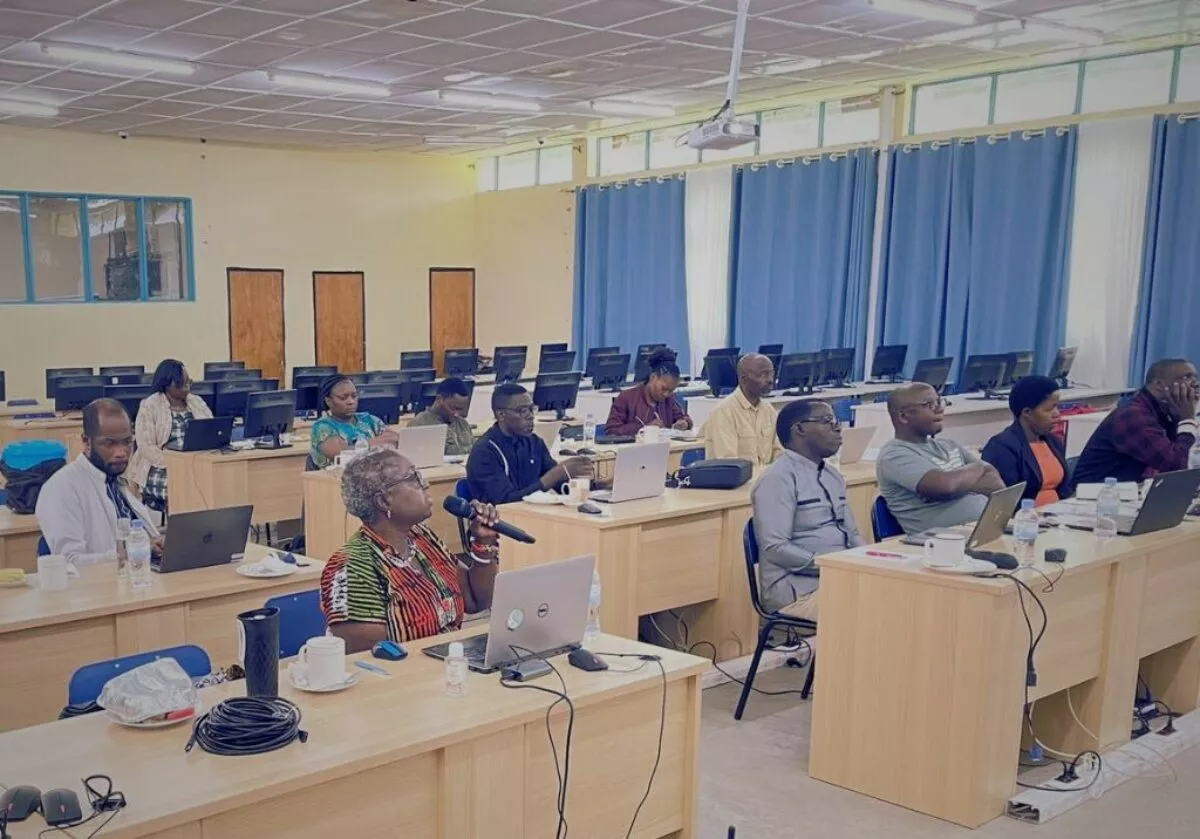
Twice a year, up to eight PhD students, postdocs and unit heads spend two days with Agent Majeur, each bringing a manuscript in progress.
Day one of this AI training covers how these systems work and where they help: brainstorming, rephrasing, literature review, journal selection and formatting. It also covers where they fail: inherited bias, plagiarism, data security, hallucination, sycophancy, cognitive debt and the human tendency to anthropomorphise chatbots. Beyond public frontier models, participants try research-specific tools and match each one to different writing stages.
Day two applies the tools to participants’ own manuscripts, with individual feedback. Scientists explore different prompt structures and learn to employ Markdown to clearly structure their instructions and content, improving the reliability and quality of their interactions with LLMs while using tokens efficiently.
Each participant leaves with a protocol for best applying these tools at different points in their process. They return to their labs using LLMs with confidence, knowing when and how to justify their use, thus establishing a coherent, up-to-date standard within Institut Pasteur.
These projets might interest you