Creating a newsletter to grow your reputation
Newsletters were once thought to be outdated and ousted by social media. Now they are making a strong comeback. And for good reason: newsletters are one of the few communication channels that you fully control. No algorithm decides whether your message gets seen. No third-party platform sets the rules. You decide who receives the content and when. That said, launching a newsletter without proper preparation exposes you to irregular sending schedules, off-topic content and a subscriber list that quickly dwindles. Here’s how to avoid these pitfalls and turn your newsletter into a powerful tool for visibility and retention.
What newsletters do better than social media
Posting on social media does not guarantee that your content will be seen. On LinkedIn, organic reach for company pages was already capped at around 2% in early 2025 and dropped further to 1.6% between February and September. In practical terms, the vast majority of your followers never see your content.
Newsletters work differently. According to the 2025 Brevo benchmark, open rates for newsletters in sectors such as healthcare, education and professional services hover around 30%. In other words, about one-third of your recipients actually open your email —provided your content is relevant and your list is qualified.
There is also a structural advantage: your subscriber list belongs to you. Whether LinkedIn shuts down tomorrow or changes its algorithm without warning, your contact base remains intact. This is a critical distinction for any organization building long-term relationships with partners, funders or clients.
Define your objectives before writing the first line
Failing to define clear objectives is a common mistake and a key reason why most newsletters are dropped after a few editions. Without a clear goal, content becomes unfocused, publishing frequency turns into a burden and results are impossible to measure. Here are a few objectives and how they shape both the content and tone of your newsletter.
Showcasing results and sharing expertise
For research labs, engineering schools or companies with strong R&D activity, newsletters are often used to highlight results and showcase areas of expertise. In this case, the newsletter becomes a knowledge-sharing tool: it makes complex work accessible to industrial partners, decision-makers or a broader audience, without compromising scientific rigor.
The challenge here is primarily editorial. You need to select the right examples, avoid jargon and structure information clearly.
Maintaining relationships with funders or sponsors
For organizations that rely on external funding, newsletters help maintain connections and keep stakeholders informed. They highlight the tangible impact of funding: a project moving forward, encouraging results, a researcher publishing new work. This type of content strengthens the sense of involvement and supports funding renewal. The tone here is more human, more narrative-driven and focused on beneficiaries.
Strengthening an internal culture of innovation
Large industrial organizations or companies with strong R&D activity can also use newsletters as an internal communication channel. They share team progress, highlight employees involved in research projects and reinforce cohesion around a shared mission. Content may serve peer-to-peer knowledge sharing or even act as a form of internal science popularization initiative for departments not directly involved in innovation activities.
Driving qualified traffic to your website and publications
Each item featured in a newsletter can include a link to a blog post, publication, event page or training offer. This direct traffic, generated from an already engaged audience, typically has a low bounce rate and contributes positively to the signals search engines use to rank web pages. Thus, newsletters don’t just build relationships, they drive visibility.
Building an editorial line to give your newsletter a clear identity
A newsletter without an editorial line is like a newspaper whose sections change with every issue. Readers don’t know what to expect, the team doesn’t know what to write and consistency fades quickly. Your editorial line is the backbone: it defines what you talk about, to whom, the tone and the format.
Choosing your sections and defining your tone
To define your tone, align it with the language level of your actual audience. Internal communication between experts requires a different language than educational content aimed at high school students. This distinction shapes vocabulary, text length, the balance between written content and visuals, and even the structure of each issue.
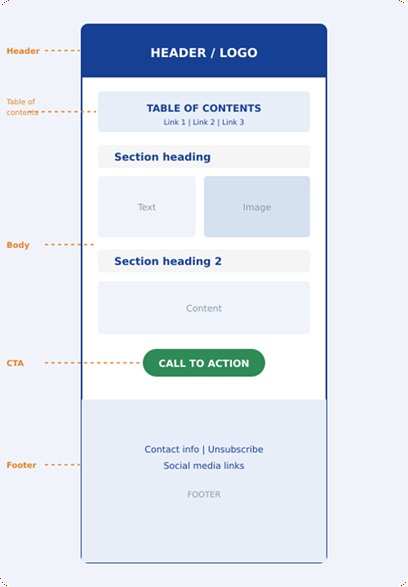
In practice, defining two or three recurring sections simplifies production and creates a sense of anticipation. For example, an organization might structure each issue around a team’s news, a clearly explained result or highlight, and an agenda of upcoming events. These fixed sections reduce writing time while giving subscribers consistent reference points.
Refining your writing
Unlike a blog post, which benefits from in-depth development, newsletters are more effective when they remain concise. Prioritize short texts that capture the essentials, simple and direct sentences, and a single key message per section. Each block of text should encourage the reader to click through to learn more and direct them to your website.
Also be mindful to avoid so-called “spam trigger” words in your content. Terms like “free”, “exclusive offer”, “special promotion” or “buy now” can activate email filters and send your newsletter straight to spam before it’s even read.
In an institutional context, this risk is relatively limited but it is still worth considering, especially when referencing paid services or call for donations.
Improving your layout and design
The quality of a newsletter depends as much on its presentation as on its content. Email platforms such as Brevo, Mailchimp or Sarbacane make it easy to create polished designs without advanced technical skills.
The key is to infuse each issue with your visual identity — colours, logo, fonts — so that your newsletter is instantly recognizable. Add photos or illustrations to make the content easier to read and make each section visually distinct using frames or colour blocks.
Also consider mobile display: more than 70% of emails are now opened on smartphones. Opt for a responsive layout (one that adapts to different screen sizes), with large buttons and text that remains readable without zooming.
Increasing clicks with compelling subject lines
The subject line is the first thing your recipient sees — and often the only thing, if it doesn’t spark enough interest to open the email. Despite high-quality content, newsletters can go unnoticed if the subject lines are dull or too generic.
A few principles can help:
• Keep subject lines short and engaging (40–60 characters). Ask a question, highlight a clear benefit or introduce a hint of narrative tension. “What our March trials revealed” is more effective than “March 2026 Newsletter.”
• Don’t overlook the preheader, the short text that appears right after the subject line in many inboxes. It extends your message and can convince hesitant readers to open. Don’t leave it blank: this valuable space is often underused.
• Personalizing with the recipient’s first name can slightly improve open rates but the effect is limited. Relevance always matters more than personalisation.
Choosing a sustainable publishing rhythm
A monthly newsletter maintained over two years is far more effective than a weekly one abandoned after three months. Irregular sending confuses subscribers, harms your sender reputation with email providers and negatively impacts deliverability. Consistency matters more than frequency.
The right rate of publication depends on the volume of news you have to share and the editorial resources available. For most organizations — where major updates don’t occur every week — a monthly newsletter is appropriate. A biweekly or weekly schedule makes sense only if your flow of content and events justifies it.
Timing also matters. It should be based on your audience’s habits and refined over time using data from your email platform. For instance, late mornings on Tuesdays and Thursdays are often effective for professional audiences.
To maintain a consistent publication rate, it is best to plan your content using a quarterly editorial calendar. This helps you anticipate key moments such as conferences, publications and calls for projects, and avoid disruptions caused by busy schedules.
Your subscriber list: the key asset of your newsletter
Launching a newsletter is one thing — having people to send it to is another. To build your audience, you need to gather subscriptions. There are several ways to do this.
The first is to add a newsletter sign-up module on your website. For example, place it in the footer in a visible spot so it is accessible from anywhere on your site. Another strategy is to offer participants the chance to join your newsletter during your events. Finally, you can include a subscription link in your emails and email signatures.
The quality of your subscriber list determines everything else. A poorly targeted or non-consenting list leads to low open rates, mass unsubscribes or worse, being flagged as spam which can compromise the deliverability of all future emails.
GDPR sets strict rules: each subscriber must give their explicit consent to receive emails. Every newsletter must also include an “unsubscribe” link. On your website, using a double opt-in — where the subscription is confirmed via a validation email — is strongly recommended to ensure list quality. However, for professional communications, legitimate interest is sufficient and sending emails without explicit consent is possible.
Measuring results with the right metrics
What isn’t measured cannot be improved. Setting indicators from the start allows you to manage your newsletter methodically and adjust content or frequency based on real results.
• Open rate: the proportion of recipients who opened the email. This reflects the appeal of your subject line and the trust in the sender. For institutional communications, 26–30% is a good benchmark. Below 20%, consider reviewing the subject line, sender reputation or list quality.
• Click rate: the proportion of readers who clicked at least on one link. This measures content relevance and the effectiveness of calls to action. It is the primary indicator if your newsletter aims to drive traffic to your website.
• Unsubscribe rate: a warning sign — over 0.5% indicates that the frequency is too high, that content does not match subscriber expectations or that the list is not segmented enough. In the French market, the average rate remains around 0.22% (Brevo, 2025).
• Traffic generated: analysing website traffic complements these email metrics, helping to measure reader engagement and interest in your content.
Ready to get started?
An effective newsletter is not something you whip up on the spur of the moment. It requires step-by-step planning: defining your objectives in advance, developing an editorial line aligned with your audience, choosing a sustainable and consistent publication rate and measuring results to improve over time. Following this approach makes production much easier on a daily basis.
Need a helping hand to get started? Discover our “Create an Engaging Newsletter” training course, which also covers the essentials of digital communication, of which newsletters are a cornerstone.
Looking for professional advice and guidance to launch your newsletter?
CONTACT-US